

Reaching farmers where they are
Climate-smart agriculture at ASA Kenya begins with a simple principle: solutions must fit farmers’ realities. In urban areas, that means working within small spaces. In rural communities, it means responding to soil degradation, water stress, and increasingly unpredictable weather.
In 2025, this approach took shape through a series of trainings that reached more than 180 client-farmers across the country. In Dandora and Mombasa, urban farmers explored rabbit rearing as a practical, low-input enterprise, learning how it can generate income, provide nutrition, and support crop production even where land is limited.
In Tala and Engineer Town, the focus shifted to broader climate-smart practices. Farmers examined how climate change is affecting their farms today and learned practical ways to protect soil, conserve water, and strengthen crop and livestock production.
Hands-on learning brought these ideas to life. In Engineer Town, farmers constructed cone and moist gardens, seeing first-hand how small plots can deliver year-round food and income. Across locations and farming systems, the message was clear. Climate-smart agriculture is not about scale. It is about smart choices, practical knowledge, and the confidence to adapt.
Across locations and farming systems, the message was clear. Climate-smart agriculture is not about scale. It is about smart choices, practical knowledge, and the confidence to adapt.
These women are mothers and caregivers. In the face of climate change, they must continue to provide for their families.
DR ALICE RUTO, DIRECTOR, KEPAWAE
500+
No. of farmers trained (2024-2025)
Partnerships that deepen impact
A key strength of the programme is collaboration with expert partners. ASA Kenya continues to work closely with KEPAWAE (‘Kenya Professional Association of Women in Agriculture and Environment’), ensuring that training content is practical, locally relevant, and grounded in best practice.
Sessions were facilitated by Dr Alice Ruto, alongside KEPAWAE facilitator Phyllis Andambi. The training used adult learning methods that combined discussion, demonstration, and peer exchange. Local leaders, including county representatives and forestry officials, also supported selected sessions, helping create strong links between farmers and local institutions.
From theory to practice: Engineer Town
In August 2025, ASA Kenya brought climate-smart agriculture into sharp focus in Engineer Town, Nyandarua County, where agriculture is the backbone of livelihoods. Nearly 100 client-farmers came together to explore what climate resilience means in practice, on their own farms and within their communities. The session focused on practical actions farmers can take to protect soils, conserve water, and strengthen crop and livestock production.
With a smaller group, the learning moved into the field at a nearby farm in Murwaki village, where Lucy Wacuka and her family opened their seven-acre farm as a living classroom. On a small 10ft by 10ft plot, farmers worked together to construct moist and cone gardens, using soil-water retention techniques, seeing first-hand how limited space can still produce food for households and surplus for sale.
A short farm tour highlighted everyday climate-smart practices already in use, including rainwater
harvesting, biogas for cooking, organic waste recycling, and seedling production, reinforcing that resilience is built through simple, affordable choices.
Client spotlight: Lydia Wacuka
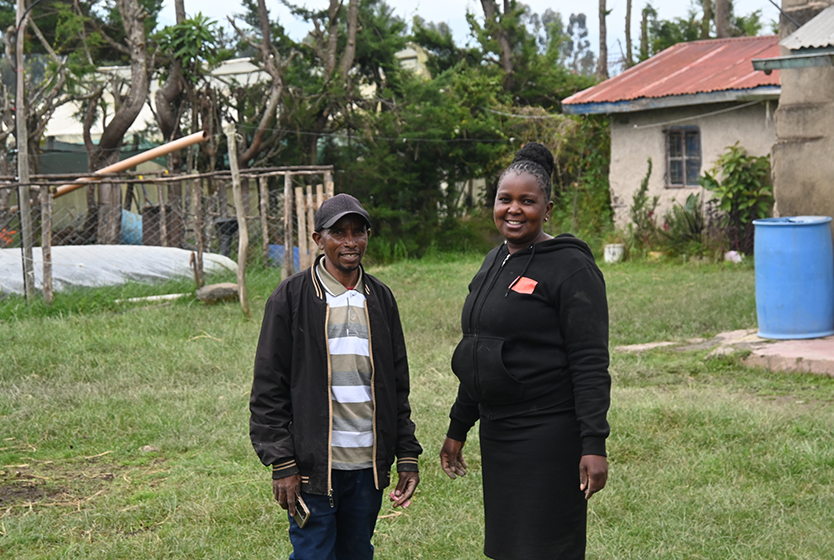
“Sharing knowledge helps others thrive. Access to timely loans and flexible repayment has helped us plan better and grow with confidence.”
Lydia Wacuka and her husband, Peter Mwangi, opened their farm to fellow ASA Kenya clients to share what has worked in building a sustainable farming business. After transitioning from government employment, their early efforts with traditional crops delivered low returns. A shift to strawberry and pea farming, supported by improved planning, research, and access to finance, changed the direction of their business and enabled consistent weekly exports.
ASA Kenya loans have played a practical role in this growth. Over eight loan cycles, Lydia has invested in farm inputs, infrastructure, and working capital, including a biogas system that now provides clean energy for cooking. Rainwater harvesting has eliminated water bills, farm waste is reused to improve soil health, and strawberry seedling sales generate additional income.
Today, the farm employs 15 people from the local community, with plans to expand further as demand grows.
Inspiration through innovation: hydroponics and new pathways
Like Lydia, other ASA Kenya clients are using what they have learned to create shared spaces for growth and experimentation. ASA Kenya is supporting innovative approaches that respond to land and water constraints, particularly in settings where traditional farming is not possible. A dedicated video feature highlights the story of Nancy Waithera, who has turned her home into a shared learning space for her group. Starting with a KES 10,000 loan, Nancy gradually expanded her business through successive loans and reinvestment. Today, she is also applying climate-smart practices through hydroponic farming.
Using minimal space and water, Nancy and her group grow vegetables for household consumption and sale. After group meetings, members tend the crops together, combining learning, food production, and income generation.
Building resilient futures
From urban rabbit farming to rural demonstration plots and hydroponic systems, ASA Kenya’s climate-smart agriculture programme continues to strengthen resilience where it matters most. By combining financial services with training, partnerships, and peer learning, the programme supports clients to protect their livelihoods, feed their families, and build more sustainable futures in a changing climate.
"Sharing knowledge helps others thrive. Access to timely loans and flexible repayment has helped us plan better and grow with confidence.”